TL;DR: Patch vCenter (CVE-2026-123890), which Mandiant says a China-nexus group has exploited since early September, and Apache Roller (6.1.6 or later), whose maintainers say its XML-RPC bug is being actively exploited; seven more bugs joined CISA's exploited list this week. If you build Python or Node.js code, check your lockfiles for agent-framework 1.26.1 or 1.26.2 and for WPPConnect 2.4.1, 2.10.82 or 2.10.83, all of which stole secrets. If your site loads Optimizely Web Experimentation, review 16 November between 07:51 and 22:24 UTC, when injected script skimmed card and crypto data on some customers' pages.
This roundup is for people who run a website, a server, a CI pipeline or a self-hosted tool, and want to know which of this week's news applies to them. It covers Monday 16 to Saturday 21 November 2026. For each story you get what happened, according to the people who found it or were hit, and the check to run on your own systems. Every check below is for systems you own or have written permission to test.
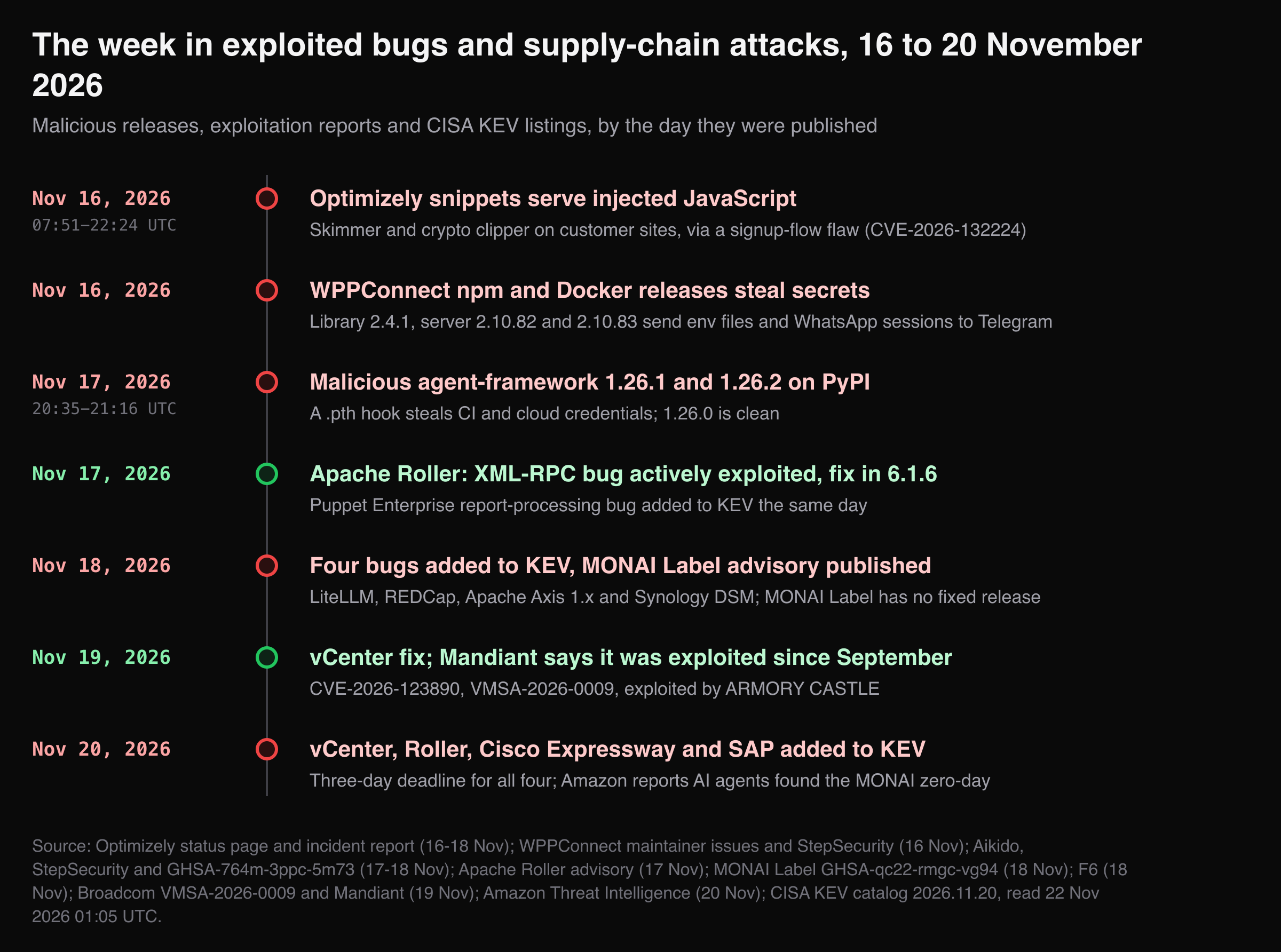
What changed since last week's roundup?
Two stories from last week's roundup moved on.
Fireworks AI: two incidents, and wider exposure than its 9 November bulletin said. On 17 November Fireworks updated its bulletin: the activity "relates to two separate security incidents". In the first, from 3 August to 7 October, an attacker used stolen Fireworks credentials and "a vulnerability in one of our services" and, for a small number of customers, reached secrets, model files and datasets. In the second, from 23 to 30 October, the attacker came in through Fireworks development machines at a third-party cloud provider "that had experienced a security incident", and "accessed account and billing information for all accounts created before Oct 30th"; card numbers were not included, because Fireworks does not store them. Last week we described a single October intrusion affecting a limited set of accounts; that is now out of date. If you have a Fireworks account opened before 30 October, treat its account and billing details as exposed, rotate your Fireworks API keys, and rotate any third-party key you ever stored there.
Xen Orchestra: a CVSS score, still no CVE. On 20 November Vates published GitHub advisory GHSA-2r3w-c2vx-fv5g for the empty-object login token bypass, rated Critical, CVSS 9.8. It still has no CVE, so it is still not on CISA's list. The fix has not changed: xo-server 5.211.2 or 5.213.1, which is Xen Orchestra 6.9.2 or 6.10.1.
The other stories have not moved. Barracuda, Microsoft, Check Point and Cisco have not revised their advisories since last week, and neither Aikido nor Endor Labs has added to its report on the wfx-loot GitHub campaign.
What do I need to patch this week?
Start with CISA's Known Exploited Vulnerabilities (KEV) catalog: a bug lands there only when CISA has evidence of exploitation in the wild. We pulled the catalog's JSON feed ourselves on 22 November at 01:05 UTC and listed what was added after last week's read (catalog 2026.11.13):
curl -s https://www.cisa.gov/sites/default/files/feeds/known_exploited_vulnerabilities.json \
  | jq -r '"catalog \(.catalogVersion), \(.count) entries",
           (.vulnerabilities[] | select(.dateAdded >= "2026-11-14")
            | "\(.dateAdded)  due \(.dueDate)  \(.cveID)  \(.vendorProject) \(.product)")'
catalog 2026.11.20, 1790 entries
2026-11-20  due 2026-11-23  CVE-2026-129448  Apache Roller
2026-11-20  due 2026-11-23  CVE-2026-123890  Broadcom VMware vCenter
2026-11-20  due 2026-11-23  CVE-2025-42884  SAP NetWeaver
2026-11-20  due 2026-11-23  CVE-2026-76466  Cisco Expressway Series
2026-11-18  due 2026-11-21  CVE-2024-10441  Synology DiskStation Manager (DSM)
2026-11-18  due 2026-12-02  CVE-2026-40217  BerriAI LiteLLM
2026-11-18  due 2026-11-21  CVE-2026-90817  Vanderbilt University Research Electronic Data Capture (REDCap)
2026-11-18  due 2026-11-21  CVE-2026-90436  Apache Axis
2026-11-17  due 2026-12-01  CVE-2026-115731  Perforce Puppet Enterprise
Nine new entries, seven of them with a three-day deadline. One thing the list does not show: for most of these bugs, the KEV listing is the only public statement of exploitation. Only Apache (for Roller) and Mandiant (for vCenter) say so in their own words, and for Cisco Expressway a researcher does while Cisco does not. If the vocabulary is new, our glossary explains what a CVE is and how to read a CVSS score.
vCenter CVE-2026-123890: exploited since early September
Broadcom's VMSA-2026-0009, issued 19 November, fixes an authentication bypass in the VMware Directory Service: an attacker with network access to vCenter can get in without credentials. It is rated Critical, CVSS 9.8, with no workaround. Fixed versions are vCenter 9.1.1.0200, 9.0.2.0200 and 8.0 U3m, and VMware Cloud Foundation 5.2.5; for vCenter 7.0, Broadcom tells customers with extended support to contact it.
The bug was reported by Mandiant, and Google's threat intelligence team says the suspected PRC-nexus group ARMORY CASTLE (formerly UNC5221) "exploited this vulnerability in early September 2026 using BONESAW, according to forensic evidence". The exploit goes through port 2012, the RPC control interface of vCenter Single Sign-On. So beyond patching, check from an ordinary workstation network whether that port answers on your own vCenter; it should only be reachable from your vCenter and ESXi hosts:
# from a network that is not your management network; replace the host name
nmap -Pn -p 2012 vcenter.your-company.example
open means anyone on that network can reach the interface the exploit uses. Mandiant's hardening advice is to drop TCP 2012 from every host not on an allowlist.
Apache Roller CVE-2026-129448: the maintainers say it is actively exploited
Apache's advisory of 17 November covers Roller 4.0.0 through 6.1.4: the XML-RPC endpoint deserializes untrusted data before authenticating the requester, which gives an unauthenticated attacker code execution. It is the same bug as CVE-2026-82384, which in September listed only 6.1.5. "This issue is being actively exploited." Upgrade to 6.1.6 or later. Note that CISA's KEV entry links the September announcement, not this one.
If you cannot upgrade today, Apache's interim fix is to set enabledForExtensions to false in WEB-INF/web.xml, or remove the /roller-services/xmlrpc servlet mapping, and restart. Turning XML-RPC off in the admin UI is not enough. To see what you run, read the version from the deployed webapp:
# inside the deployed Roller webapp directory
grep '^ro.version' WEB-INF/classes/roller-version.properties
grep -n 'roller-services/xmlrpc' WEB-INF/web.xml
A deserialization bug in an endpoint that answers before login is the kind of thing an attack-surface map of your own app is there to surface: an old blog engine on a forgotten subdomain counts.
Cisco Expressway CVE-2026-76466: CISA and a researcher say exploited, Cisco does not
Cisco's advisory, published 21 October, describes hard-coded credentials in Expressway-C and Expressway-E that give root on devices "configured in a cluster". CVSS 9.8, "no workarounds". The fix is X15.5.20; X14 and earlier must migrate to a fixed release. As of this week Cisco still says it "is not aware of any public announcements or malicious use".
The Russian security company F6 reported on 18 November a first case of exploitation against a company in Russia running X15.5.3, soon after a public proof of concept appeared. CISA listed it two days later. F6 gives one indicator, the string nodeup,'wombat@127.0.0.1' in erlang.log, and advises restricting TCP 4371–4372 to trusted cluster peers until you upgrade.
LiteLLM CVE-2026-40217: an AI gateway on the exploited list
LiteLLM is a proxy many teams put in front of their LLM providers. Its advisory GHSA-wxxx-gvqv-xp7p says the /guardrails/test_custom_code endpoint runs user-supplied Python inside a hand-rolled sandbox that can be escaped, giving code execution in the proxy process, "which runs as root in the default Docker image". Reaching the endpoint requires a proxy-admin credential in default configurations, which is why the maintainers rate it medium. Affected versions are 1.81.8 up to 1.83.10; the advisory's text says the fix is in 1.83.11, so upgrade to 1.83.11 or later. Until then, block POST /guardrails/test_custom_code at your reverse proxy. To check what you run:
docker exec <litellm-container> pip show litellm | grep '^Version'
The admin credential is the real boundary here, so this is also the week to check who holds the LiteLLM master key and whether its admin port is reachable from anywhere it should not be.
The rest of the list
| CVE | Product | What to do | Note |
|---|---|---|---|
| CVE-2026-115731 | Puppet Enterprise and Puppet Core | Upgrade to PE 2026.0.1, 2025.12.1 or 2023.8.13 (Core 9.1.3 or 8.22.2), then restart Puppet Server | Any client with a CA-signed agent certificate can run code; unauthenticated if your CA autosigns (Perforce) |
| CVE-2026-90817 | REDCap | Upgrade to 16.0.49 LTS, 17.3.10 LTS or 17.4.4 | Needs a valid public survey hash (CVE record) |
| CVE-2026-90436 | Apache Axis 1.x | No fixed release: Axis 1.x is end of life; migrate | Look for axis-1.4.jar or axis:axis in your dependency tree (Apache) |
| CVE-2024-10441 | Synology DSM, BeeStation | DSM 7.2-64570-4, 7.2.1-69057-6 or 7.2.2-72806-1; BeeStation 1.1-65374 | A 2024 bug, fixed since 2024, now exploited (Synology) |
| CVE-2025-42884 | SAP NetWeaver Enterprise Portal 7.50 | Apply SAP Note 3660969 (November 2025 Patch Day) | SAP rates it Medium, 6.5 (SAP) |
The Synology entry is the pattern to remember: a bug patched in 2024 reaches KEV when someone finally uses it against the devices nobody updated.
Did a poisoned package reach my builds this week?
Two open-source packages shipped malicious releases this week, and both steal secrets. Check your lockfiles and your CI logs, not only what is installed today.
agent-framework 1.26.1 and 1.26.2 on PyPI
On 17 November two releases of agent-framework appeared on PyPI within 33 minutes and were quarantined shortly after (Aikido, StepSecurity). GitHub's malware advisory GHSA-764m-3ppc-5m73 lists exactly 1.26.1 and 1.26.2; 1.26.0 is clean and is again the latest release. Both install a .pth file, which Python runs at every interpreter start, so the code runs even if nothing imports the package. It collects secret-looking environment variables, cloud and registry credential files and .env files, tries to mint fresh tokens from cloud metadata and CI identity endpoints, and posts the lot to a webhook.site URL. StepSecurity says the evidence "does not establish the initial access vector".
# lockfiles and requirements
grep -rnE 'agent-framework.{0,6}1\.26\.[12]' --include='*.txt' --include='*.lock' --include='*.toml' .
# the startup hooks, found without starting Python
find / \( -name 'agent_framework_meta.pth' -o -name 'af_runtime_diag.pth' -o -name 'af_runtime_diag.py' \) 2>/dev/null
Use find, not pip show: StepSecurity warns that any command that starts Python on an infected host runs the hook again. If either version was installed anywhere, pin agent-framework==1.26.0, rebuild the images and CI caches made since 17 November, rotate every secret that environment could read, and search your egress logs for webhook.site.
WPPConnect: malicious npm and Docker releases from the project's own pipeline
WPPConnect is a WhatsApp automation library and server. On 16 November its maintainer flagged library 2.4.1 and server 2.10.82 as malicious (library issue, server issue), and StepSecurity's analysis adds server 2.10.83 and the matching wppconnect/wppconnect-server Docker images. The code runs when the library is imported or the server starts, not at install, so --ignore-scripts does not help. It sends environment variables, .env and config files and the WhatsApp session files under ./tokens/ to a Telegram bot. The last clean versions are library 2.4.0 and server 2.10.81. Both issues were still open when we checked on 22 November.
npm ls @wppconnect-team/wppconnect @wppconnect/server
ls -la "$(node -p "require('os').tmpdir()")"/.wpp-* 2>/dev/null
A hit means rotating everything in that host's environment and config, and unlinking the WhatsApp devices whose sessions were stored there. Our article on software supply chain security covers the controls that limit what one poisoned dependency can reach.
A coding-agent config file as a backdoor
On 16 November Google's threat intelligence group described intrusions at cryptocurrency organisations in North America and Europe in which a suspected MIDNIGHT NEPTUNE cluster, after getting in through fake recruiters and "ClickFix" lures, modified .claude/settings.json in internal repositories "so that when users started up Claude Code, it would automatically trigger the download of the SOMBERMEME backdoor". GTIG describes no product vulnerability: the attacker edited a project configuration file that the tool trusts. Check the history of agent configuration files in your repositories, and review any hook that downloads or runs something:
git log --oneline -- .claude/settings.json .vscode/tasks.json
grep -n '"hooks"' -A8 .claude/settings.json 2>/dev/null
Putting .claude/, .vscode/ and CI workflow files under CODEOWNERS review is the same control the vibe-coded app checklist recommends for anything that runs code on a developer's machine.
Was my website serving Optimizely's injected code?
Only if it loads Optimizely Web Experimentation and Optimizely has told you that you were affected; check the window anyway if you cannot rule it out. According to Optimizely's incident report, on 16 November an attacker "exploited a vulnerability in the Optimizely Web Experimentation account signup flow" to act as administrator users and insert malicious JavaScript into the Project JavaScript of some customer projects. The first malicious code was written at 07:51 UTC; Optimizely detected it at 13:34, closed the hole at 16:10 and had removed the injected code by 22:24 UTC. Its status page says fewer than 5% of customers were affected and that it was "not a credentials breach". The flaw is tracked as CVE-2026-132224 and was fixed on Optimizely's side; there is nothing to install.
What the script did is documented by Report URI, which found malicious code in 188 of the 1,611 Optimizely snippets it checked, across 178 organisations: first a crypto-address clipper, then from 13:43 UTC a card skimmer reading card fields typed into the site's own forms. Optimizely says cards entered in hosted payment iframes were not accessible, and that sites with a strong Content Security Policy were protected. Injected first-party script has the same reach as stored XSS, which is why CSP made the difference.
On your own site:
# CDN, WAF, proxy or CSP-report logs for 16 November
zgrep -E '1688360\.cc|5vobauua3ojpklx\.icu|eil786npto9u5bq\.icu|l7bcsnwc7nzr3uo\.icu|webshell\.lol|linkforge\.cc' /var/log/nginx/*.log*
Then open each Optimizely project's Project JavaScript and look for code you did not write. Optimizely's own list of actions: confirm which pages ran the snippet between 07:51 and 22:24 UTC on 16 November, treat any page with card or crypto entry as high risk, review transactions from that window, keep your logs, and take legal advice on notification. Its early advice to turn the snippet off has been withdrawn.
What was exploited without a CVE?
MONAI Label, a medical-imaging AI annotation server, has an exploited zero-day and no fixed release. On 20 November Amazon Threat Intelligence reported that a China-nexus actor's autonomous AI agents, given the goal "obtain shell access", found a path traversal in "an open-source medical imaging AI application" and used it to write a reverse shell into sitecustomize.py, getting "a reverse shell running as root". Amazon assesses "with high confidence" that it was a zero-day, and links the project's advisory, GHSA-qc22-rmgc-vg94, published 18 November: PUT /datastore/image and PUT /datastore/label write files anywhere the process can, and "authentication is disabled by default". Every monailabel release up to 0.8.5, the latest on PyPI, is affected; the fix is merged in the project's main branch but not yet released, and there is no CVE, so KEV will not list it.
If you run MONAI Label, keep it off the internet, set MONAI_LABEL_AUTH_ENABLE=True, run it as an unprivileged user, and look for a sitecustomize.py you did not put there:
pip show monailabel | grep '^Version'
python3 -c "import site; print('\n'.join(site.getsitepackages()))" | xargs -I{} find {} -maxdepth 1 -name sitecustomize.py
The speed is the other story: an agent that maps an API and tries a filename parameter for traversal does in minutes what used to take a person an afternoon. That is the same work you can do first on your own app, which is the reason legal practice targets exist.
What was fixed this week with no exploitation reported?
Two updates worth taking on your normal schedule. Chrome 158 reached the stable channel on 17 November (158.0.8127.36 and later) with 204 security fixes; Google marks none of them as exploited. And F5 fixed an HTTP/2 flaw in NGINX, CVE-2026-123007, in NGINX Open Source 1.31.9 and 1.30.7 and NGINX Plus 37.0.8.1 and 37.3.0.1; it only matters if HTTP/2 is on, which sudo nginx -T | grep -n http2 shows.
Key takeaways
- Patch vCenter to 9.1.1.0200, 9.0.2.0200 or 8.0 U3m and check that port 2012 is not reachable from user networks; then Apache Roller to 6.1.6, or disable its XML-RPC extensions today.
- Search lockfiles, CI logs and images for agent-framework 1.26.1 or 1.26.2 and WPPConnect 2.4.1, 2.10.82 or 2.10.83; a hit means rotating every secret that environment could read.
- If your site loads Optimizely Web Experimentation, review 16 November 07:51 to 22:24 UTC, and put a strict Content Security Policy on pages that take payments.
- Treat agent and editor configuration files (
.claude/,.vscode/) as code: review their history and put them under CODEOWNERS. - Read KEV weekly, but not alone: this week's MONAI Label zero-day and last week's Xen Orchestra bug have no CVE and never appear there.
FAQ
What is CVE-2026-123890, and is my vCenter affected?
It is an authentication bypass in the VMware Directory Service of vCenter, fixed by Broadcom on 19 November 2026 in VMSA-2026-0009. Unpatched vCenter 7.0, 8.0, 9.0 and 9.1 are affected; fixed builds are 9.1.1.0200, 9.0.2.0200 and 8.0 U3m. Mandiant says a suspected PRC-nexus group exploited it from early September 2026, so patch first and then look for unexpected access.
Was the agent-framework package on PyPI really malicious?
Yes. Versions 1.26.1 and 1.26.2, published on 17 November 2026, installed a Python startup hook that stole credentials and sent them to an external webhook; GitHub lists both in malware advisory GHSA-764m-3ppc-5m73. Version 1.26.0 is clean. If either bad version was installed, pin 1.26.0, rebuild, and rotate secrets.
Do I need to do anything about the Optimizely incident?
If your site uses Optimizely Web Experimentation, yes: Optimizely asks every customer to check which pages ran its snippet between 07:51 and 22:24 UTC on 16 November 2026 and to review payments and crypto transfers from that window. The flaw itself was fixed on Optimizely's side, so there is nothing to install, and Optimizely has withdrawn its early advice to switch the snippet off.
Why is LiteLLM on CISA's list if its maintainers rate the bug medium?
The maintainers rate it medium because reaching the vulnerable endpoint needs a proxy-admin credential. CISA lists bugs by evidence of exploitation, not by score, and it added CVE-2026-40217 on 18 November 2026. Upgrade to 1.83.11 or later and block POST /guardrails/test_custom_code until you do.
How often does HackerGPT publish this roundup?
Every Sunday, covering the week before. Each one starts from our own read of CISA's KEV feed and links only to primary sources: vendor advisories, the researchers' own reports and the affected organisations' statements.
Sources
- CISA Known Exploited Vulnerabilities catalog (feed read 22 November 2026 01:05 UTC, catalog 2026.11.20)
- Fireworks AI: update on October 2026 security incidents (17 November 2026) and Vates GHSA-2r3w-c2vx-fv5g (20 November 2026)
- Broadcom VMSA-2026-0009 and Google Threat Intelligence: ARMORY CASTLE exploits vSphere (19 November 2026)
- Apache Roller: CVE-2026-129448 (17 November 2026)
- Cisco: Expressway static credential vulnerability and F6 press release (18 November 2026, in Russian)
- LiteLLM GHSA-wxxx-gvqv-xp7p
- Perforce: Puppet report deserialization, CVE-2026-90817 (REDCap), Apache Axis: CVE-2026-90436, Synology SA-24:20 and SAP Security Notes 2025
- Aikido: two malicious agent-framework releases, StepSecurity: agent-framework compromised and GHSA-764m-3ppc-5m73
- StepSecurity: WPPConnect compromised and the maintainers' issues for the library and server
- Google Threat Intelligence: agentic threat activity (16 November 2026)
- Optimizely incident report (17 November 2026, updated 18 and 20 November), Optimizely status page, CVE-2026-132224 and Report URI's analysis
- Amazon Threat Intelligence: AI agents found a zero-day (20 November 2026) and MONAI Label GHSA-qc22-rmgc-vg94
- Chrome Releases: Chrome 158 stable (17 November 2026) and CVE-2026-123007 (NGINX)
To see what your own site exposes before someone else maps it, run HackerGPT against it, or practise the techniques above on CyberGym.